
Part 7 — Jesus and Muhammad Compared
Two Different Claims of Revelation
Every religion ultimately depends on its foundation.
A building is only as strong as the foundation upon which it stands.
In the same way, every religious system must be examined by asking:
Who is its founder?
What authority does that founder possess?
What message did they proclaim?
Can their claims be verified?
Islam and Christianity both make claims about God, revelation, and salvation. However, they are built upon two very different foundations.
Christianity is built upon the person, death, and resurrection of Jesus Christ.
Islam is built upon the message and authority claimed by Muhammad.
Therefore, the central question is:
Should we follow Jesus Christ as revealed in Scripture, or Muhammad as presented in Islam?
Jesus Is Not Merely a Religious Teacher
The Bible presents Jesus as completely unique.
He is not simply one prophet among many.
He is not merely a messenger pointing people toward God.
He is God the Son who came in the flesh.
John wrote:
> “And the Word became flesh and dwelt among us, and we saw His glory, glory as of the only Son from the Father, full of grace and truth.” (John 1:14 NASB
Jesus claimed a unique authority:
> “All authority in heaven and on earth has been given to Me.” (Matthew 28:18 NASB)
He did not point people to another future prophet.
He pointed people to Himself.
Muhammad Claimed to Be a Messenger
Islam teaches that Muhammad was the final prophet and messenger of Allah.
However, Muhammad did not claim to be God.
He did not claim to have authority over creation.
He did not claim to forgive sins.
He did not claim to defeat death.
The Qur’an presents Muhammad as a servant and messenger.
This creates a fundamental difference:
The Bible presents Jesus as the divine Son of God.
Islam presents Muhammad as a human prophet.
These are not equivalent claims.
Jesus’ Authority Over Sin
One of the greatest differences between Jesus and every other religious figure is His authority over sin.
When Jesus healed a paralysed man, He first said:
> “Son, your sins are forgiven.” (Mark 2:5 NASB)
The religious leaders understood the significance:
> “Who can forgive sins except God alone?” (Mark 2:7 NASB)
They recognized that Jesus was exercising God’s authority.
Jesus did not merely tell people how to seek forgiveness.
He personally provided forgiveness.
Muhammad Did Not Claim Authority to Forgive Sin
According to Islamic teaching, Muhammad was a messenger who delivered Allah’s revelation.
He called people to submit to Allah and follow the commands given through him.
However, he did not claim to be the sacrifice for humanity’s sins.
He did not claim to have conquered death.
He did not offer salvation through his own work.
This is a major difference from Jesus.
The Gospel does not say:
“Follow Jesus’ teachings and try harder.”
The Gospel says:
“Trust in what Jesus has already accomplished.”
Jesus Predicted His Death and Resurrection
Jesus repeatedly told His disciples that He would suffer, die, and rise again.
He said:
> “The Son of Man will be delivered into the hands of men, and they will kill Him, and when He has been killed, He will rise three days later.” (Mark 9:31 NASB)
After His resurrection, Jesus said:
> “Thus it is written, that the Christ would suffer and rise from the dead on the third day.” (Luke 24:46 NASB)
The cross was not a failure.
It was the fulfilment of God’s plan.
The Resurrection Separates Jesus From Every Other Religious Leader
Every major religious leader eventually died.
Jesus is unique because Christianity is based on the claim that He rose bodily from the dead.
Paul wrote:
> “If Christ has not been raised, your faith is worthless; you are still in your sins.” (1 Corinthians 15:17 NASB)
The resurrection is not an optional belief.
It is the foundation of Christianity.
Without it:
There is no victory over death.
There is no forgiveness of sin.
There is no hope of eternal life.
Jesus Offered Eternal Life as a Gift
Jesus said:
> “Truly, truly, I say to you, the one who believes has eternal life.” (John 6:47 NASB)
Notice His words:
“The one who believes.”
Not:
“The one who earns.”
Not:
“The one who becomes good enough.”
Not:
“The one who performs enough religious deeds.”
Salvation is received by faith because Christ has completed the work.
Paul wrote:
> “For the wages of sin is death, but the gracious gift of God is eternal life in Christ Jesus our Lord.” (Romans 6:23 NASB)
The Islamic View of Salvation
Islam teaches submission to Allah and obedience to his commands.
A Muslim’s final destiny is traditionally understood to depend on Allah’s judgment and mercy.
This means salvation is not based on the completed work of a Saviour who has paid the full penalty for sin.
The Qur’an presents a system where deeds are weighed and Allah’s mercy is sought.
From the biblical perspective, this is fundamentally different from the Gospel.
The Bible teaches:
> “For by grace you have been saved through faith; and this is not of yourselves, it is the gift of God; not a result of works, so that no one may boast.” (Ephesians 2:8–9 NASB)
Two Different Messages
The message of Jesus:
God has acted to save sinners. Jesus paid the price. Trust in Him and receive eternal life as a gift.
The message of Islam:
Submit to Allah, follow his commands, and seek his mercy.
These are not the same Gospel.
One rests entirely on Christ’s finished work.
The other places the final outcome upon judgment and mercy.
The Greatest Difference: Grace vs Works
The Bible teaches:
> “But to the one who does not work, but believes in Him who justifies the ungodly, his faith is credited as righteousness.” (Romans 4:5 NASB)
The believer’s righteousness comes from Christ.
It is not earned.
It is received.
Paul declared:
> “I have been crucified with Christ; and it is no longer I who live, but Christ lives in me; and the life which I now live in the flesh I live by faith in the Son of God.” (Galatians 2:20 NASB)
A Final Invitation to Consider Jesus
The purpose of this comparison is not to attack people.
It is to examine truth claims.
Many Muslims sincerely desire to honour God.
But sincerity alone cannot save.
The most important question remains:
Who is Jesus Christ?
Jesus said:
> “Unless you believe that I am He, you will die in your sins.” (John 8:24 NASB)
The Bible calls every person to turn from their sin and place their trust in Christ alone.
Not in religious effort.
Not in human righteousness.
Not in tradition.
But in Jesus Christ, who died and rose again.
> “Believe in the Lord Jesus, and you will be saved.” (Acts 16:31 NASB)
Coming Next: Part 8 — The Gospel of Grace vs The Islamic Path of Salvation
The next chapter will examine the greatest difference between Christianity and Islam:
Can sinners be saved by God’s grace alone, or must they depend upon their own works and hope for mercy at judgment?
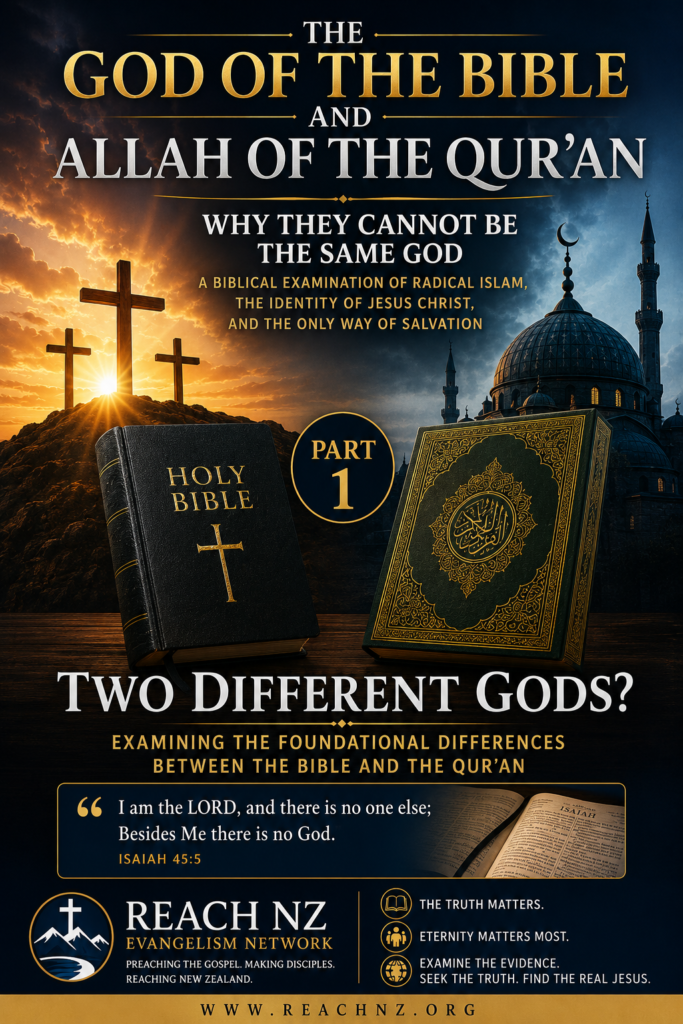
PART 8: The God of the Bible and Allah of the Qur’an
Why They Cannot Be the Same God
A Biblical Examination of Radical Islam, the Identity of Jesus Christ, and the Only Way of Salvation