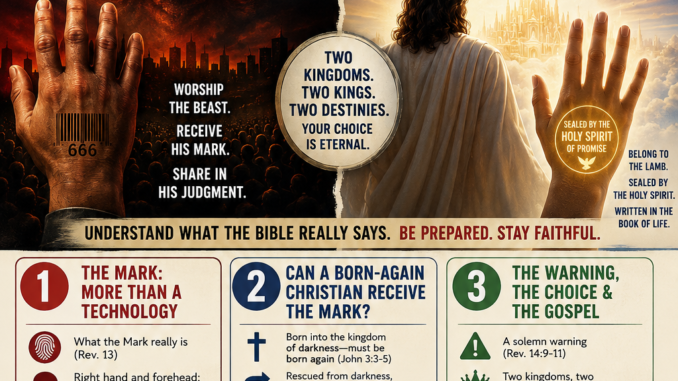
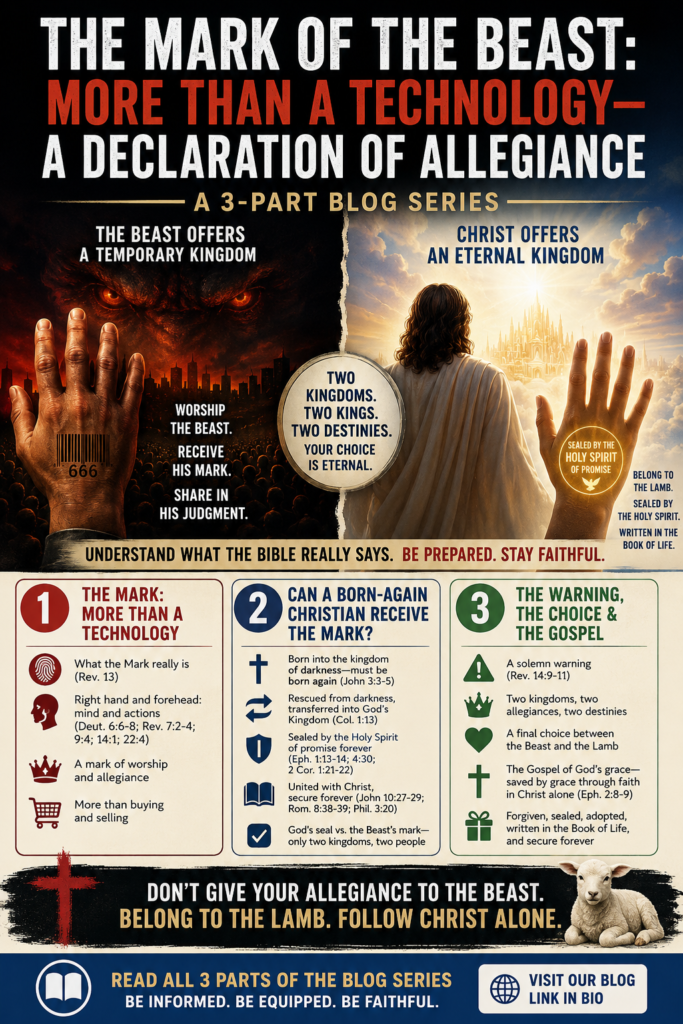
- Part 1 explains what the Mark of the Beast is and why it is fundamentally about worship and allegiance.
- Part 2 explains why those who have been born again, transferred into God’s Kingdom, and sealed with the Holy Spirit belong to Christ and need not fear receiving the Beast’s mark.
- Part 3 concludes with the contrast between the two kingdoms and presents the gospel, calling readers to trust in Christ alone for eternal salvation.
- Part 4 explains how you must be born again to enter the Kingdom of God
Few subjects in Bible prophecy have generated as much speculation as the Mark of the Beast. Over the years, Christians have suggested it could be a barcode, a tattoo, an RFID chip, a biometric implant, or some other form of technology. While these ideas are common, the Bible itself never identifies the mark as any of these things.
Rather than interpreting Revelation through the lens of modern technology, we should allow Scripture to define its own terms.
The Meaning of “Mark”
The Greek word translated “mark” in Revelation 13 is charagma (χάραγμα). It means an engraved mark, an imprint, a stamp, a brand, or a carved inscription. In the first-century Roman world, the word referred to marks of ownership, official seals, imperial stamps, and brands placed upon slaves or animals.
The emphasis of charagma is not the method by which the mark is applied but what it signifies—ownership, authority, and allegiance.
This means a literal, permanent, visible brand or inscription on the right hand or forehead is entirely consistent with the meaning of the Greek word.
Why the Right Hand and Forehead?
The locations of the mark are just as significant as the mark itself.
Throughout Scripture, the forehead represents a person’s mind, beliefs, and loyalty, while the right hand represents a person’s actions, works, and service.
In Deuteronomy 6:6–8, God instructed Israel to bind His Word upon their hands and between their eyes. The point was that His Word should govern both their thinking and their actions.
The Book of Revelation uses the same imagery.
- God seals His servants on their foreheads (Revelation 7:2–4).
- The demonic locusts are forbidden to harm those who bear God’s seal (Revelation 9:4).
- The 144,000 have the name of the Lamb and His Father written on their foreheads (Revelation 14:1).
- In eternity, God’s servants will have His name written on their foreheads (Revelation 22:4).
- By contrast, the followers of the Beast receive his mark on their right hand or forehead.
- The contrast is intentional.
- God identifies those who belong to Him.
- The Beast identifies those who belong to him.
- The forehead symbolises a person’s allegiance, beliefs, and way of thinking.
- The hand symbolises the outward expression of that allegiance through one’s actions and service.
A Literal Mark With Spiritual Meaning
There is no need to separate the literal and symbolic aspects of the Mark of the Beast.
The mark may be a literal, permanent, visible brand or inscription while simultaneously carrying profound spiritual significance.
Like a wedding ring visibly represents a marriage covenant, the Mark of the Beast may visibly identify those who have willingly aligned themselves with the Beast’s authority.
The physical mark would therefore symbolise a deeper spiritual reality: the person’s mind, actions, and worship now belong to the Beast.
The Mark Is About Worship
One of the clearest truths in Revelation is that the mark is inseparable from worship.
Revelation consistently joins three realities together:
- Worshiping the Beast.
- Receiving his mark.
- Sharing in his judgment.
Those who worship the Beast receive his mark.
What will you choose?
Those who refuse to worship him refuse his mark.
The mark is therefore far more than an identification system. It is a public declaration of allegiance to the Beast’s kingdom in rebellion against Jesus Christ.
More Than Buying and Selling
- Revelation 13:17 states that no one can buy or sell without the mark.
- Economic control is undoubtedly part of the Beast’s system.
- However, buying and selling are not the primary purpose of the mark.
- The economy becomes the means by which the Beast pressures the world to choose between loyalty to Christ and loyalty to himself.
- This is why reducing the Mark of the Beast to a computer chip, digital currency, biometric ID, or other technology misses the central message of Revelation.
- Technology may or may not play a role in how the mark is administered.
Scripture does not tell us.
What Scripture does make clear is that the mark represents ownership, worship, and allegiance. It identifies those who willingly submit themselves to the Beast’s authority and become citizens of his kingdom.
To understand the Mark of the Beast correctly, we must first understand the two kingdoms presented throughout Scripture and why every person must be born again to enter the Kingdom of God.