
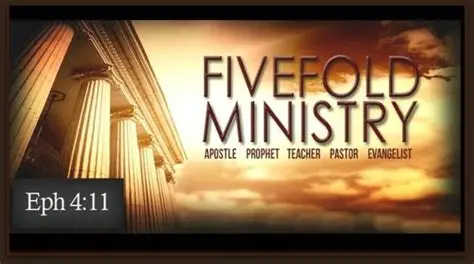
In Ephesians 4:11-13 (NASB), Paul declares:
“And He gave some as apostles, some as prophets, some as evangelists, some as pastors and teachers, for the equipping of the saints for the work of ministry, for the building up of the body of Christ; until we all attain to the unity of the faith, and of the knowledge of the Son of God, to a mature man, to the measure of the stature which belongs to the fullness of Christ.”
These five leadership gifts—commonly called the fivefold ministry—are given by the ascended Christ to His Church. Importantly, the text says Christ gave some to be apostles, some prophets, some evangelists, some pastors and teachers. These roles are not distributed to every believer but to specific individuals whom God sovereignly calls and equips. Their primary purpose is to equip the saints (all believers) for works of ministry, so that the entire Body of Christ grows into maturity and unity.
Not every disciple is called to one of these equipping offices, yet every disciple is called to minister, bear fruit, and participate in the Great Commission.
The Evangelist: The Most Misunderstood Fivefold Ministry

Of the fivefold ministries, the role of the Evangelist has become one of the most misunderstood in the modern Church. Many assume that an evangelist is simply someone who preaches the gospel to unbelievers—often picturing a travelling preacher holding large crusades or street outreach.
While evangelists certainly proclaim the good news, this limited view misses the biblical emphasis and purpose of the gift.
Scripture clearly distinguishes between two related but distinct concepts:
- The fivefold ministry gift of Evangelist (Ephesians 4:11)
This is an equipping office given to some believers. Its primary focus is inside the Church, training and mobilising the saints for effective outreach. - The ministry of evangelism
This is the responsibility of every believer, including those with the fivefold gift of Evangelist. We are all called to share the gospel with the lost (Matthew 28:19-20; Acts 1:8; 1 Peter 3:15).
The fivefold Evangelist certainly engages in personal evangelism and may preach to crowds of unbelievers as the Lord leads (as Philip did in Acts 8). However, their primary calling according to Ephesians 4 is not to sinners but to the saints—to equip God’s people for works of service.
What the Ministry of the Evangelist Includes
The ministry of the fivefold Evangelist centres on equipping believers to become confident, effective witnesses who reach the lost in their everyday lives. Practically, this includes:
- Stirring and imparting a burning passion for the lost within the church
- Teaching believers how to clearly and boldly proclaim the gospel message
- Training disciples in practical outreach skills—such as initiating spiritual conversations, sharing personal testimony, answering common objections, and leading someone to Christ
- Equipping the church in apologetics, cultural engagement, and contextualised evangelism
- Developing and implementing strategies for community outreach, missions, and church planting
- Cultivating a pervasive evangelistic culture where every member sees themselves as a harvester in the Kingdom
- Gathering and mobilising teams for organised outreach while ensuring those efforts train and release others to continue the work
The Evangelist’s greatest impact comes as they prepare ordinary disciples to confidently go out into their communities, workplaces, schools, and neighbourhoods to reach the lost. Their role is to multiply ministry, turning the whole Body into a dynamic force for the Great Commission.
When we misunderstand this, churches often expect the Evangelist to do most of the “soul-winning” themselves, while the rest of the Body remains passive. But God’s design is the opposite: the Evangelist equips the many to reach the many, multiplying the harvest far beyond what one person could ever achieve alone.
The Decline of the Church and the Neglect of the Fivefold Ministry
One of the most significant reasons the Church in general—and particularly the Western Church—has been in decline for generations is the failure to allow the full fivefold ministry to function as God intended.
When apostles, prophets, evangelists, pastors, and teachers are not recognised, honoured, and released to equip the saints, the Body remains immature, divided, and ineffective in its mission. Instead of every believer being trained and empowered for ministry, the work falls to a few professionals, while the majority sit passively. The result is spiritual stagnation, loss of evangelistic zeal, and a Church that struggles to impact culture.
This decline has been compounded by the widespread acceptance of cessationism—the doctrine that certain spiritual gifts and ministries ceased with the apostles. Like a cancer, this teaching has spread through much of the Body of Christ, robbing believers of the very tools God provided for growth and maturity. It has led to unbelief regarding the ongoing ministry of the Holy Spirit through apostles, prophets, and the miraculous gifts.
Even many so-called Pentecostal and charismatic churches, while rejecting formal cessationism, have fallen away from the biblical patterns of Ephesians 4 and 1 Corinthians 14. In seeking the manifestation of the Spirit, they have often drifted into hyper-emotionalism, disorder, and unbiblical manifestations that exalt experience over Scripture and edification. The orderly, every-member participation described in 1 Corinthians 14—where gifts are exercised decently and in order for the building up of the Body—has frequently been replaced by uncontrolled spectacles that quench true spiritual growth and bring reproach on the name of Christ.
God’s design for the gathered Body of Christ is clearly revealed in 1 Corinthians 14: when believers come together, every one is to be an active participant in ministry, not a passive spectator. Paul instructs, “When you come together, each one of you has a psalm, has a teaching, has a revelation, has a tongue, has an interpretation. All things are to be done for edification” (v. 26). The meeting is to be interactive and mutually edifying—believers contributing as the Spirit leads, under orderly oversight, so that all are strengthened, encouraged, and comforted (v. 3, 31). This is the normative pattern for the New Testament Church: a family gathering where every member functions, bringing what God has given them for the common good.
Over the generations, however, this pattern has been largely abandoned. Professionalism, fear of disorder, and traditions of men have turned most church gatherings into performances where one or a few minister from the front, while the vast majority remain silent spectators. This directly contradicts God’s intention and hinders the maturity He desires, because believers are not practised in hearing the Spirit or ministering to one another.
The early Church operated according to this participatory pattern in 1 Corinthians 14, where all believers were encouraged to minister spiritual gifts in gathered meetings for the edification of the Body. Prophecy, tongues, interpretation, and other gifts flowed freely under orderly leadership to strengthen and mature the saints. But through unbelief, fear of excess, or pursuit of sensationalism, much of the Church has departed from this biblical pattern, quenching the Spirit (1 Thessalonians 5:19-20) and grieving Him by disregarding or distorting His gifts (Ephesians 4:30).
A Prophetic Call to Repentance
I believe the Lord is saying to His Church:
“My beloved Bride, I have given you ascension gifts—apostles, prophets, evangelists, pastors, and teachers—to bring you to full maturity. Yet for generations you have rejected them, silenced them, and explained them away through doctrines born of unbelief. Cessationism has infected My Body like a cancer, spreading doubt and fear where there should be faith and expectation. You have quenched My Spirit and despised the very gifts I poured out to build you up.
You have forsaken the pattern of My early Church, where My people gathered and each one ministered as I led—prophesying, speaking in tongues, interpreting, revealing My heart—for the common good and the edification of all. Instead, you have chosen control over surrender, tradition over My living Word, and human wisdom over the power of My Spirit.
Repent, My Church! Turn from the unbelief that has robbed you of My power and left you weak and declining. Return to Me in humility. Open your hearts again to the full ministry of My Spirit. Recognise and receive the apostles and prophets I am restoring. Release the evangelists to equip My people for harvest. Honour the pastors and teachers who shepherd and ground you in truth.
No longer grieve My Spirit by denying His gifts. Believe My Word again. Pursue love and eagerly desire spiritual gifts, especially that you may prophesy. As you obey, I will heal your wounds, restore your strength, and cause you to rise as a radiant Bride, mature and equipped, advancing My Kingdom with power until I return.
The harvest is plentiful, but the labourers are few because My equippers have been silenced. Repent, and I will pour out My Spirit afresh upon you.”
Women in the Fivefold Ministry
Scripture clearly shows that women can operate in several of the fivefold ministries:
- Prophets: Numerous women prophesied under the inspiration of the Spirit (Miriam – Exodus 15:20; Deborah – Judges 4:4; Huldah – 2 Kings 22:14; Anna – Luke 2:36-38; Philip’s four daughters – Acts 21:9; and women prophesying in the Corinthian church – 1 Corinthians 11:5).
- Evangelists and Teachers: Women such as Priscilla (who, with her husband, explained the way of God more accurately to Apollos – Acts 18:26) and others demonstrate teaching and evangelistic roles.
- Apostles: Junia is described as “outstanding among the apostles” (Romans 16:7).
However, the Bible sets clear boundaries regarding authority. Paul teaches in 1 Timothy 2:11-14 and 1 Corinthians 14:34-35 that women are not permitted to exercise authoritative teaching or governance over men in the assembled church. This principle is grounded in God’s created order before the Fall (1 Timothy 2:13-14; Genesis 2-3).
The role of pastor (synonymous with elder/overseer in the New Testament) involves authoritative shepherding, ruling, and doctrinal teaching over the whole congregation, including men. The qualifications for elders/pastors are consistently described in male terms (“husband of one wife” – 1 Timothy 3:2; Titus 1:6), and the function includes authority that Scripture reserves for qualified men.
Therefore, while women may fully function as prophets, evangelists, teachers (in contexts such as women’s or children’s ministry, or alongside their husbands), and even apostles, they are not to hold the office of pastor/elder or exercise spiritual authority over men in the church.
This distinction does not diminish the value, gifting, or vital contribution of women—men and women are equal in worth and salvation (Galatians 3:28)—but reflects God’s wise design for order, complementarity, and flourishing in the Body of Christ.
Conclusion
The hour is urgent. The Lord is calling His Church in New Zealand and beyond to awaken from complacency and return wholeheartedly to His biblical pattern. As we repent of unbelief, embrace the full fivefold ministry, restore participatory gatherings where every believer ministers, and release the equipping gifts Jesus gave, we will see the Body of Christ rise in maturity, unity, and power.
At Reach NZ, we are committed to this restoration: honouring the ascension gifts for some to equip all, upholding Scripture’s order in leadership and authority, and mobilising every disciple—men and women alike—into active, fruitful ministry. Together, in obedience and faith, we will see communities transformed, cities reached, and a mighty harvest brought in for the glory of Jesus Christ. The Bride is being prepared—let us respond without delay.
Contact Us

If you have any questions or would like more information, please complete our Contact Form. Add the name of this blog, The Fivefold Ministry: Gifts for Some, to Equip All, then add your message