As followers of Jesus Christ at Reach NZ, we are committed to upholding the truth of God’s Word above all traditions, institutions, or human authorities. The Bible calls us to “test everything; hold fast what is good” (1 Thessalonians 5:21) and to discern truth from error, especially in matters of faith and salvation.
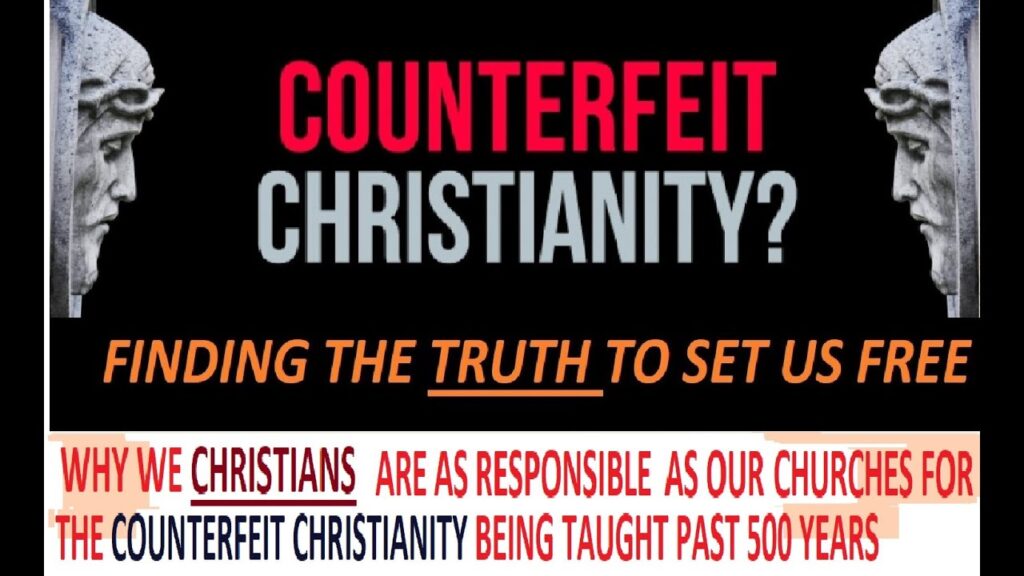
In this teaching, we will examine why the Roman Catholic Church (RCC) cannot be considered a true Bible-believing, born-again Christian church or denomination. From its historical inception in the fourth century onwards, the RCC has never been a Bible-believing Christian Church; it has always been a counterfeit Christianity—a system that uses Christian terminology while fundamentally deviating from the apostolic faith revealed in Scripture. Scripture and history reveal it as a counterfeit system that deviates from the apostolic faith. We will explore the nature of the true Church, the RCC’s unfounded claims about its origins, its historical emergence, and its core doctrines that contradict the Bible. Our goal is not to attack individuals but to point people to the pure gospel of Jesus Christ, where salvation is by grace alone through faith alone in Christ alone.
This teaching is not a call for Catholics to leave one institutional church and join a Protestant denomination or another human organisation. It is an urgent invitation to return to the Bible’s apostolic roots—to the simple, pure faith and gospel preached by the apostles in the first century. The apostles knew nothing of popes, hierarchies, sacraments as means of grace, or salvation earned through works and rituals. They preached salvation by grace alone through faith alone in Christ alone, resulting in being born again by the Spirit of God and becoming part of the universal body of Christ. We call every Catholic (and every person) to embrace this original apostolic gospel, free from later additions and traditions of men.
The True Church: Not a Denomination or Organisation, but the Universal Body of Born-Again Believers
The Bible defines the Church not as a human institution, denomination, or organisation with hierarchical structures, but as the universal (catholic, meaning “universal”) body of all born-again believers in Jesus Christ.
Jesus Himself said, “I will build my church, and the gates of hell shall not prevail against it” (Matthew 16:18). This Church is spiritual and invisible in its essence, composed of those who have been regenerated by the Holy Spirit—born again, as Jesus taught Nicodemus: “Truly, truly, I say to you, unless one is born again he cannot see the kingdom of God” (John 3:3).
The Apostle Paul describes the Church as the “body of Christ,” with Christ as its only head: “And he is the head of the body, the church” (Colossians 1:18). There is no room for a human vicar (substitute) like a pope; Christ alone leads His people through His Word and Spirit. Ephesians 4:4-6 emphasises unity in “one body and one Spirit… one Lord, one faith, one baptism, one God and Father of all.” This body transcends denominations, buildings, or organisations—it’s all true believers from every nation, tribe, and tongue (Revelation 7:9).
The Roman Catholic Church has deceitfully appropriated the biblical term “catholic” (meaning universal) and redefined it to refer to their visible, hierarchical organisation, complete with popes, cardinals, traditions, sacraments, and mandatory membership. They claim that the “one true Catholic Church” is this institution, and that salvation is tied to submission to its authority and traditions. This is a profound deception. The true catholic (universal) Church is not an organisation with human traditions elevated to the level of Scripture; it is the spiritual body of all born-again believers worldwide, united solely by faith in Christ, with Jesus Himself as the only Head. No earthly institution can claim to be the exclusive embodiment of the universal Church—such a claim replaces Christ with human structures.
By elevating its institution, hierarchy, and pope to the place of supreme authority—claiming to be the visible head of the Church, the dispenser of salvation through sacraments, and the infallible interpreter of truth—the RCC has effectively replaced Christ with itself. This substitution makes the system Antichrist in nature. The Greek word “antichristos” (Antichrist) literally means “in place of Christ” or “instead of Christ” (anti = against or in place of). While Scripture speaks of a future individual “man of lawlessness” (2 Thessalonians 2:3-4) and many Antichrists who deny Christ’s full deity or humanity (1 John 2:18, 22; 4:3), the spirit of Antichrist is anything that opposes or takes the place of Christ in His rightful role as Head, Mediator, and Savior. The RCC’s claim that there is “no salvation outside the Church” (meaning their institution) and that submission to the pope is necessary for unity with Christ directly usurps Christ’s unique position, placing a human organisation in His stead.
Furthermore, God desires a direct, personal relationship with each of His children, with no human intermediary standing between us and Him. Jesus Christ is our one and only Mediator: “For there is one God, and there is one mediator between God and men, the man Christ Jesus” (1 Timothy 2:5). Through His finished work on the cross, the veil in the temple was torn in two (Matthew 27:51), symbolising that every believer now has direct access to the Father (Hebrews 4:16; 10:19-22). We do not need priests, popes, or saints to approach God—Christ’s blood alone grants us bold entrance into His presence. The RCC’s system of human mediators undermines this glorious truth and keeps people dependent on an organisation rather than trusting Christ directly.
In contrast, the RCC claims to be the one true church, with exclusive authority through its hierarchy. This institutional view contradicts Scripture, which warns against divisions and human lords over faith (1 Corinthians 1:10-13). True Christians are united not by membership in an organisation but by faith in Christ, producing fruit through the indwelling Holy Spirit (Galatians 5:22-23).
The RCC Did Not Exist in the First Century: Only Seven Churches Mentioned in Scripture
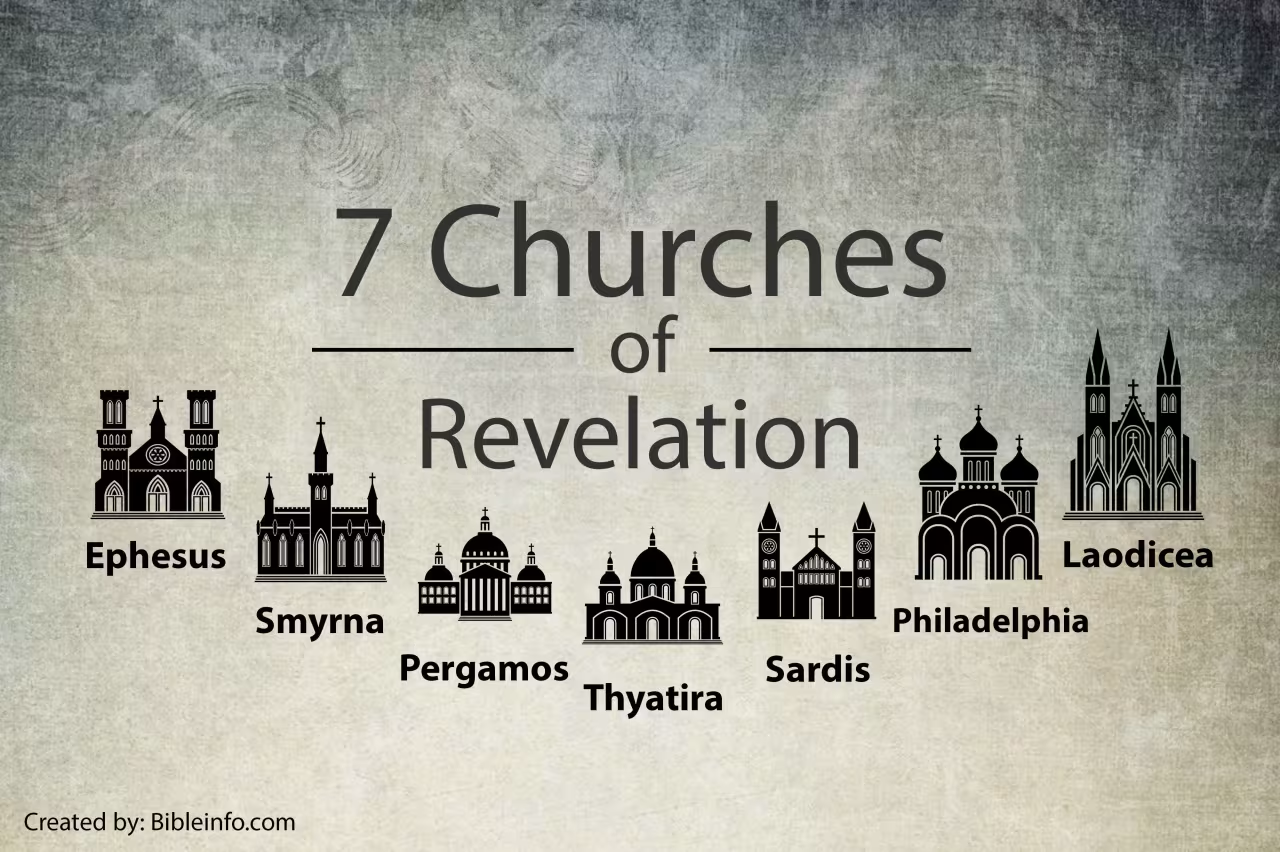
Scripture and early church history confirm that the RCC, as we know it, did not exist in the first century. The Book of Revelation, written around AD 95 by the Apostle John, addresses letters to seven specific churches in Asia Minor (modern-day Turkey):
Ephesus, Smyrna, Pergamum, Thyatira, Sardis, Philadelphia, and Laodicea (Revelation 2-3). These were local assemblies of believers, not a centralised Roman institution. None bore any resemblance to Roman Catholicism—no popes, no Marian devotion, no purgatory, no transubstantiation.
The New Testament mentions house churches and local gatherings in cities like Rome, Corinth, Galatia, and Thessalonica, but there is no evidence of a “Roman Catholic Church” with Peter as pope or Rome as the supreme seat. The early church was decentralised, led by elders (presbyters) and apostles, with decisions made collectively, as seen in the Jerusalem Council (Acts 15). Historical records from first-century writers like Clement of Rome (c. AD 96) or Ignatius of Antioch (c. AD 107) describe bishops as local overseers, not a monarchical papacy. The concept of a “pope” as supreme ruler over all Christians emerged centuries later, influenced by Roman imperial structures rather than apostolic teaching.
If the RCC were the true church founded by Christ, why does Revelation—God’s final prophetic word—omit any mention of a Roman headquarters or papal authority? The silence is telling: the first-century church was simple, Bible-based, and focused on Christ, not rituals or hierarchies.
The RCC’s Foundation on the Lie of Peter as the First Pope
The RCC claims apostolic succession from Peter as the “first pope,” based on a misinterpretation of Matthew 16:18: “And I tell you, you are Peter, and on this rock I will build my church.”
They assert that Peter (Greek: Petros, meaning “small stone”) is the “rock” (petra, meaning “large rock” or “bedrock”) upon which the church is built, granting him and his supposed successors (popes) infallible authority.
This is a counterfeit foundation, built on taking the verse out of context. Let’s examine the full passage (Matthew 16:13-19). Jesus asks His disciples, “Who do you say that I am?” Peter replies, “You are the Christ, the Son of the living God.” Jesus responds, “Blessed are you, Simon Bar-Jonah! For flesh and blood has not revealed this to you, but my Father who is in heaven. And I tell you, you are Peter, and on this rock I will build my church.”
The context shows the “rock” is not Peter himself, but the revelation Peter received from God: that Jesus is the promised Messiah (Christ). This confession of faith in Christ’s identity is the foundation. Peter, like any believer, was a “living stone” built upon this rock (1 Peter 2:4-5), but he was not the cornerstone—that role belongs to Christ alone: “For no one can lay a foundation other than that which is laid, which is Jesus Christ” (1 Corinthians 3:11). Even Peter later affirms this, calling Christ the “cornerstone” (1 Peter 2:6-7, quoting Isaiah 28:16).
Historically, there is no solid evidence Peter was ever bishop of Rome in a papal sense. The Bible records Peter as an apostle to the Jews (Galatians 2:7-8), ministering in Jerusalem and Antioch, not ruling from Rome. Early lists of Roman bishops (e.g., from Irenaeus, c. AD 180) place Linus or Anacletus as first, not Peter. The papal claim was retroactively invented to consolidate power.
Why is a true foundation critical? Just as a building collapses if built on sand (Matthew 7:24-27), a church built on human authority will fail. The Bible warns, “Cursed is the man who trusts in man and makes flesh his strength” (Jeremiah 17:5). Our foundation must be Christ alone—His person, work, and Word—not popes, traditions, or organisations. As Isaiah prophesied, “Behold, I am the one who has laid as a foundation in Zion, a stone, a tested stone, a precious cornerstone, of a sure foundation” (Isaiah 28:16). Deviating from this leads to spiritual ruin.
The Historical Emergence of the RCC Under Constantine
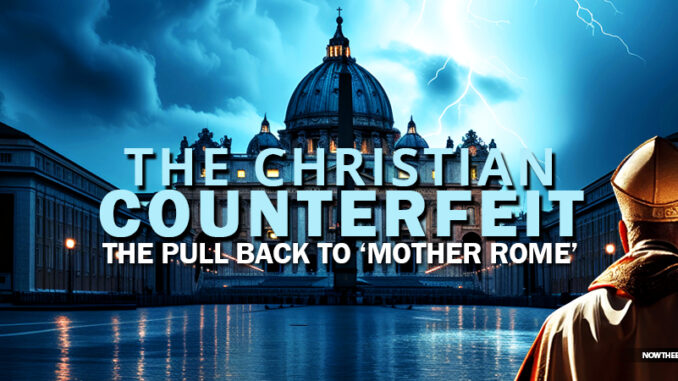
The RCC as an institution did not appear until the fourth century, during Emperor Constantine’s reign. In AD 313, Constantine issued the Edict of Milan, legalising Christianity after centuries of persecution.
By AD 380, under Emperor Theodosius I, Christianity became the official religion of the Roman Empire (Edict of Thessalonica). This merger of church and state marked the beginning of the Roman Catholic system—not the true Church, but a politicised counterfeit blending pagan Roman elements with Christian terminology. From its very formation, the RCC incorporated unbiblical hierarchies, rituals, and doctrines that departed from Scripture, making it a counterfeit form of Christianity rather than the Bible-believing faith of the apostles.
Constantine convened the Council of Nicaea in AD 325 to unify doctrine, but this was imperial oversight, not apostolic purity. The true Church had already existed for centuries as persecuted believers faithful to Scripture. The post-Constantine “church” adopted Roman hierarchies, rituals, and titles (e.g., “Pontifex Maximus” from pagan emperors became a papal title). This institutionalization led to corruption, as power centralized in Rome.
Salvation is not by joining a church or denomination but by personal repentance and faith, leading to being born again (John 3:5-7; 1 Peter 1:23). One becomes part of the universal body of Christ instantly upon conversion (1 Corinthians 12:13), not through baptism into an organisation. Jesus said, “The kingdom of God is not coming in ways that can be observed… for behold, the kingdom of God is in the midst of you” (Luke 17:20-21)—it’s spiritual, not institutional.
Unbiblical Core Doctrines of the RCC
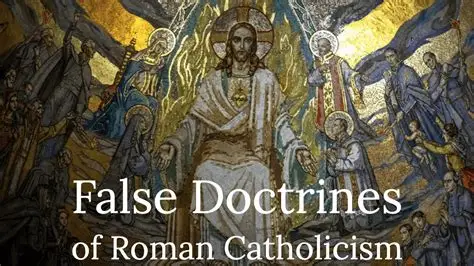
The RCC’s doctrines further expose it as counterfeit, contradicting clear biblical teaching. Here are key examples:
- Mariology and Praying to a Dead Mary: The Bible honors Mary as blessed (Luke 1:42), but she was a sinner needing a Savior (Luke 1:47). Praying to her or saints violates the command to pray only to God (Matthew 6:9; 1 Timothy 2:5—”There is one mediator between God and men, the man Christ Jesus”). Necromancy (communicating with the dead) is forbidden (Deuteronomy 18:10-12). Mary’s perpetual virginity and assumption are unbiblical inventions from later centuries.
- Transubstantiation: The RCC teaches the bread and wine literally become Christ’s body and blood in the Mass, re-sacrificing Him. But Jesus’ sacrifice was “once for all” (Hebrews 10:10, 14). The Lord’s Supper is a memorial (1 Corinthians 11:24-25), not a literal transformation. This doctrine emerged in the Middle Ages, not from apostles.
- Purgatory: The idea of a post-death purification contradicts “It is appointed for man to die once, and after that comes judgment” (Hebrews 9:27). Salvation is complete in Christ; no further atonement is needed (Romans 8:1).
- Praying to Dead Saints: Similar to Mariology, this ignores Christ’s sole mediation and the Bible’s silence on invoking the deceased.
Most damning is the RCC’s false gospel: salvation by grace plus works, sacraments, and church membership (Catechism of the Catholic Church, paragraphs 1987-2029). Paul condemns this: “But even if we or an angel from heaven should preach to you a gospel contrary to the one we preached to you, let him be accursed [anathema]” (Galatians 1:8). Anathema means “accursed” or “devoted to destruction,” leaving one under the curse of the law (Galatians 3:10)—eternal separation from God unless repented of. The true gospel is “by grace you have been saved through faith. And this is not your own doing; it is the gift of God, not a result of works” (Ephesians 2:8-9). Adding works nullifies grace (Romans 11:6).
Conclusion: The Apostolic Gospel and a Call to Repentance
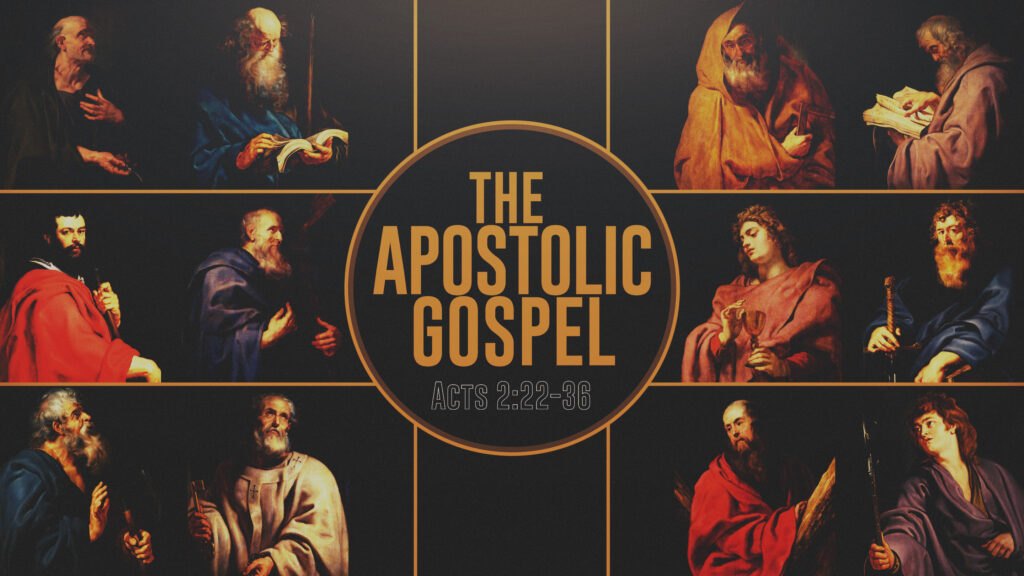
Dear reader, if you are in the RCC or any system adding to the gospel, we urge you: “Come out of her, my people” (Revelation 18:4). Trust Christ alone for salvation. The true Church is the body of born-again believers, with Jesus as Head.
Study the Bible daily (Acts 17:11), and join a local fellowship that preaches the pure gospel.
This is the clear gospel message the apostles preached: All humanity is born in sin, separated from God, and unable to save ourselves by good works, religious rituals, or sacraments (Romans 3:23; Isaiah 64:6). God, in His love, sent His Son Jesus Christ—fully God and fully man—to live a perfect life and die on the cross as the perfect sacrifice for our sins. He took the punishment we deserved, crying out, “It is finished!” (John 19:30)—the debt fully paid, the work completely done. On the third day, He rose from the dead, conquering sin and death, proving He is Lord (1 Corinthians 15:3-4).
Salvation is offered freely to all who repent and believe this gospel. To repent means to change your mind: to agree with God about your sinful condition (that you were born a sinner, helpless to earn heaven), to turn from trusting in your own efforts, religious system, or traditions, and to rely completely on Christ’s finished work alone for forgiveness and eternal life. As Peter preached on the day of Pentecost: “Repent and be baptised every one of you in the name of Jesus Christ for the forgiveness of your sins, and you will receive the gift of the Holy Spirit” (Acts 2:38). Paul declared, “Believe in the Lord Jesus, and you will be saved” (Acts 16:31).
If you are Catholic, we lovingly call you today to repent—to change your mind about depending on the RCC’s system for salvation—and to place your full trust in Jesus Christ alone. Receive His free gift of salvation by faith, be born again by the Holy Spirit, and become part of His universal body. At Reach NZ, we invite you to contact us for more resources, prayer, or to discuss this further. May the Lord open your eyes to His glorious apostolic gospel.
Contact Us
If you have any questions or would like more information, please complete our Contact Form. Add the name of this blog, Why the Roman Catholic Church is a Counterfeit Christian Church, then add your message
Reach NZ is committed to equipping Kiwis to share this hope through evangelism. Explore our resources and join us in reaching New Zealand with the gospel.
In Christ’s love,
The Reach NZ Ministry Team
www.reachnz.org