
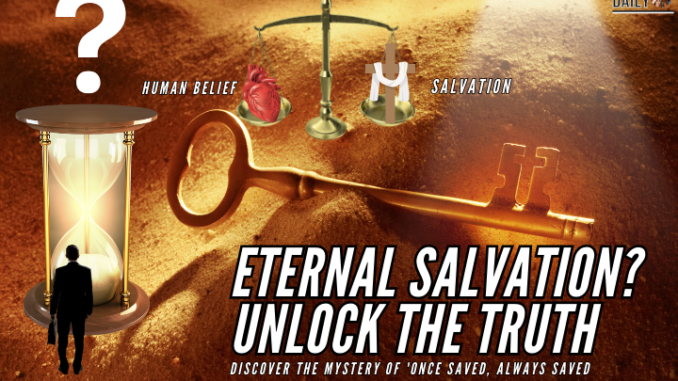
Many Christians today have been told that if they believe in eternal security — that a true believer cannot lose their salvation — they must therefore be Calvinists. This claim is simply not true. It comes from confusion about what the Bible actually teaches about salvation, predestination, and the security of the believer.
The doctrine of eternal security does not come from Calvinism. It comes from the clear teaching of Scripture. Believing eternal security simply means believing what the Bible says about the power of God to save and keep those who belong to Him.
A key passage often misunderstood is found in Epistle to the Romans 8:29.
Romans 8:29 (NASB95) says: “For those whom He foreknew, He also predestined to become conformed to the image of His Son, so that He would be the firstborn among many brethren.”
This verse is often used by Calvinists to claim that certain individuals were predestined to be saved while others were predestined to be lost. But that is not what the verse actually says.
The verse does not say people were predestined to believe or predestined to be saved. Instead, it says that those whom God foreknew were predestined to become conformed to the image of His Son.
In other words, the predestination described here is not about who will be saved. It is about what will happen to those who are already saved.
God has determined that every true believer will ultimately be transformed into the likeness of Christ. This is the destiny of the redeemed. Jesus is called the firstborn among many brethren because God is forming a family of people who will ultimately reflect the image of His Son.
This truth actually supports eternal security.

If God has predestined believers to be conformed to the image of Christ, then their final salvation cannot fail. God’s purpose cannot be overturned by human weakness. Once someone truly belongs to Christ, their final destiny is guaranteed by God Himself.
The verse begins by saying “those whom He foreknew.” God knows the future perfectly. He knows who will respond to the gospel and place their faith in Christ. On the basis of that foreknowledge, He has predetermined the destiny of those believers.
The predestination is therefore about the destiny of believers, not the selection of who will believe. This understanding fits perfectly with many scriptures that show salvation is offered to all people.
- First Epistle to Timothy 2:4 teaches that God “desires all men to be saved and to come to the knowledge of the truth.”
- Second Epistle of Peter 3:9 says that God is “not wishing for any to perish but for all to come to repentance.”
- Gospel of John 3:16 declares that “whoever believes in Him shall not perish, but have eternal life.”
But what exactly is eternal life?

Eternal life is not merely living forever. Every human being will exist forever somewhere. Eternal life is a specific kind of life — the life of God given to those who believe in Christ. It is a restored relationship with God that begins the moment a person believes the gospel and continues forever.
Jesus defined eternal life in Gospel of John 17:3:
“This is eternal life, that they may know You, the only true God, and Jesus Christ whom You have sent.”
Eternal life means entering into a living relationship with God through Jesus Christ. It begins when a person believes the gospel and continues forever into eternity.
Because it is eternal, it cannot be temporary. If eternal life could be lost, then it was never eternal to begin with.
This is why the security of salvation rests on God’s faithfulness to His promises, not on human effort. God promises eternal life to those who believe in His Son. If that life could be lost, God’s promise would fail. But Scripture teaches that God cannot lie and always keeps His word.
To understand this more clearly, we must understand how humanity became sinners in the first place.
Many people assume we became sinners because of the individual sins we personally commit. But the Bible teaches something different.
Epistle to the Romans 5:12 explains:
“Through one man sin entered into the world, and death through sin, and so death spread to all men.”
Humanity became sinful because of Adam’s disobedience. Through his sin, the human race fell and every person was born with a sinful nature.
This truth is explained further in Epistle to the Romans 5:19:
“For as through the one man's disobedience the many were made sinners, even so through the obedience of the One the many will be made righteous.”
Because Adam was the head of the human race, his disobedience brought sin and death into the world. Every human being is therefore born separated from God and possessing a sinful nature.
We do not become sinners because we sin. We sin because we are sinners by nature.
But just as Adam’s disobedience brought condemnation to humanity, the obedience of Christ provides righteousness and life for those who believe the gospel.
When a person believes in Christ, they are spiritually reborn and brought into a new relationship with God.
That is why Jesus said in Gospel of John 3:3 that a person must be born again.
Salvation is not merely forgiveness for past sins. It is the gift of new life.
Once someone is born again, they become part of a new spiritual family under a new head — Christ instead of Adam.
Because of this, it is impossible for a believer to become a lost sinner again in the same way humanity originally became lost. Humanity fell because of one man’s disobedience. None of us can repeat Adam’s unique act that brought sin upon the human race.
In the same way, salvation is secured through one man’s obedience — the obedience of Jesus Christ.
Just as Adam’s act brought condemnation to humanity, Christ’s finished work brings justification and life to those who believe.
Jesus Himself declared the security of believers in Gospel of John 10:28–29:
“I give eternal life to them, and they will never perish; and no one will snatch them out of My hand.”
Our salvation is not held together by our strength but by God’s power. The same God who saves us is the One who keeps us.
The apostle Paul expresses this confidence in Epistle to the Philippians 1:6:
“He who began a good work in you will perfect it until the day of Christ Jesus.”
- God finishes the work He begins.
- Scripture also teaches that Christ Himself is able to keep believers saved forever.
Epistle to the Hebrews 7:25 says:
“He is able also to save forever those who draw near to God through Him, since He always lives to make intercession for them.”
However, some people misunderstand eternal security and assume that those who believe it think Christians can live in sin without consequences. That idea is completely false.
While salvation cannot be lost, believers are still accountable to God for how they live. When a believer wanders into sin, God disciplines them as a loving Father disciplines His children.
Epistle to the Hebrews 12:6 says:
“For those whom the Lord loves He disciplines.”
- God’s discipline is correction, not condemnation.
- In addition, the works of every believer will one day be examined by Christ.
First Epistle to the Corinthians 3:13–15 explains that the works of believers will be tested by fire. If the works remain, the believer will receive a reward. If the works are burned up, the believer will suffer loss. But the passage also clearly states that the believer will still be saved, yet so as through fire.
- This judgment is not about salvation. It is about rewards.
- Some believers will receive great eternal rewards because they faithfully followed Christ and did the works God prepared for them to do.
- Others will enter heaven with little to show for their lives.
Epistle to the Hebrews 11:6 teaches that God is a rewarder of those who diligently seek Him.
- Unbelievers do not truly seek God. Jesus said in Gospel of John 6:44:
- “No one can come to Me unless the Father who sent Me draws him.”
- Those who respond to God and believe the gospel are those whom the Father has drawn to Christ.
- God desires every believer to live faithfully and receive eternal rewards. Scripture teaches that God prepared good works for believers long before they were born.
- Epistle to the Ephesians 2:10 says believers were created in Christ Jesus for good works which God prepared beforehand.
- Anything done in obedience to Christ will produce eternal reward. Anything done in the flesh will not last.
- For this reason, eternal security should motivate believers to live faithfully, not carelessly. Some believers will receive great eternal rewards, while others will enter heaven with only their salvation.

Finally, the reason anyone can be saved is because of the gospel of the grace of God that the apostles preached.
The Bible teaches that all humanity stands guilty before God because of sin. Through Adam’s fall, sin entered the human race and every person is born separated from God.
Yet God, in His love and mercy, provided a way of salvation.
Jesus Christ, the Son of God, came into the world and lived a sinless life. He went to the cross where He suffered and died as the substitute for sinners.
According to the gospel preached by the apostles in First Epistle to the Corinthians 15:3–4, Christ died for our sins, was buried, and rose again on the third day.
On the cross, Jesus took upon Himself the punishment that our sins deserved. After three days, God raised Him from the dead, proving that His sacrifice for sin had been accepted.
Scripture teaches that a day of judgment is coming when every person will stand before God. Those who reject Christ will face eternal separation from God, but those who have receive Him have eternal life.
The good news is that a sinner is saved by grace alone through faith alone in Christ alone.
Epistle to the Ephesians 2:8–9 says:
“For by grace you have been saved through faith; and that not of yourselves, it is the gift of God; not as a result of works, so that no one may boast.”
Salvation cannot be earned by works, religion, or obedience to the law. It is a free gift received by trusting completely in Christ and His finished work on the cross.
Adding works, religious rituals, or sacraments to the finished work of Christ changes the gospel and turns it into a false message that cannot save. Anyone who trusts in their own works instead of Christ alone remains under the curse that came through Adam’s sin.
But when a sinner believes the gospel and trusts in Christ alone, God forgives their sins, credits them with the righteousness of Christ, and gives them new life.
They are born again, made a new creation, and brought into a living relationship with God.
From that moment forward they belong to Christ, are kept by His power, and will ultimately be conformed to the image of His Son.
This is the gospel of grace the apostles preached, and it is the message by which sinners are saved.
Contact Us

If you have any questions or would like more information, please complete our Contact Form. Copy and paste the name of this blog, Eternal Security Is Not Calvinism, then add your message
Reach NZ is committed to equipping Kiwis to share this hope through evangelism. Explore our resources (see category list) and join us in reaching New Zealand with the gospel.
In Christ’s love,
The Reach NZ Ministry Team
www.reachnz.org